Fuses and breakers perform the same function, overload protection. In the event of an overload or short circuit in the properties wiring or appliances the fuse or breaker will shut off the power to that circuit, preventing a fire or electrocution.
A fuse that is overloaded will “blow”, turning off the power to that circuit. The fuse must then be replaced with a new fuse.
Breakers do the same job but may be reset with the flick of the switch. Normally breakers do not need to be replaced.
If fuses blow or circuit breakers trip on a regular basis there is a problem and an electrician should be brought in to examine the wiring and determine what the problem is.
 Do not replace the breaker or the fuse with one of higher amperage. Breaker and fuse sizes are matched to the wire size on the circuit. Incorrectly matched wiring could be a serious fire hazard.
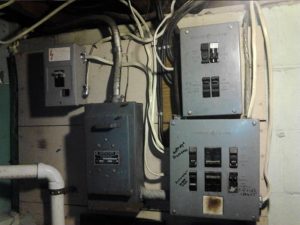
In most cases there is no reason for replacing an older style fuse or breaker panel for a new one if the old one is in good working condition, and is adequately sized for the load.
Sometimes the older style panels do not have extra spaces for adding new or additional circuits, but do have the amperage to supply more circuits than it can due to its design limitations. If there is adequate amperage for the additional circuits it is possible to add a sub panel. This is a second  panel that has power fed to it by the main panel. Doing this will give the additional breakers needed, without the expense of replacing the main panel.
NOTE: All breakers and fuses should be labeled showing the circuits they serve. It is a good idea to mark the fuse size on fused circuits.