It pays to take care of your septic tank. With proper care, a septic system should give very little, or for that matter, no trouble at all. But, if it is used with little or no regard for its well being, it can (and will) become one of your biggest headaches.
 A septic system is a highly efficient, self-contained, underground waste water treatment system that generally consists of a septic tank, a distribution box and a drain (leach) field.
The septic tank is a watertight box, usually made of concrete or fiberglass with an inlet and outlet pipe or baffle. The drains and sewage pipes carry the waste water from the house to the septic tank.
Waste water in the septic tank forms three layers. The heavier organic solids and other indigestible matter settle to the bottom forming the sludge layer. The lighter solids, such as grease, rise to the top forming the scum layer. The organic solids liquefied by bacteria ingestion become part of the middle layer of clarified, or clean, liquid.
 The clarified liquid travels to the distribution box, which makes room in the tank for more raw wastewater. The distribution box disburses the clarified liquid to the drain field. The drain field, or leach field, is a series of underground, perforated pipes (or in older installations a series of clay tiles (pipes) that disburses the liquid into the soil.
In some newer systems there are two separate leach fields with a switch over valve that allows the home owner to change from using one leach field to the other. This prevents the leach field from becoming waterlogged and over used.
 Some leach fields are higher than the septic tank and a pump is needed to get the water from the septic tank up to the leach field. The pump should have an alarm that warns you if it shuts down or malfunctions. The alarm should be positioned so that it can be heard in the living area of the house.
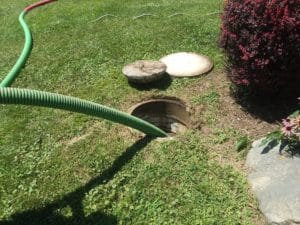
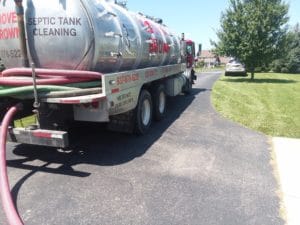
It is important know the location of your septic tank. This information will be necessary when the tank needs to be inspected or pumped. Avoid driving over the tank or the leach field with cars or trucks (lawn and smaller tractors are OK).
If the septic system’s location is unknown, it may be possible to obtain records of its location from your local health department. If they do not have records, a septic contractor will be able to locate it for you.